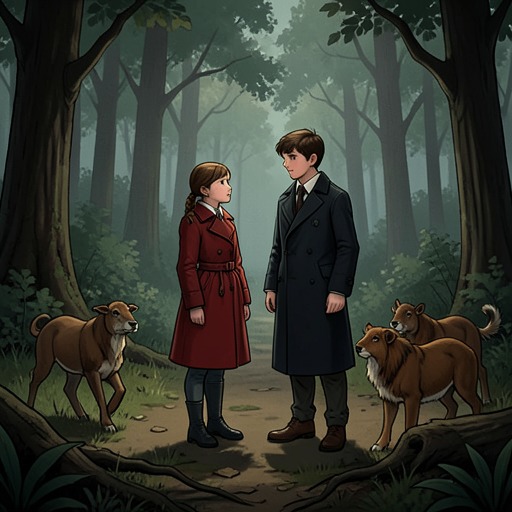
The forest belongs to all living things
Ronja, the Robber's DaughterThe forest belongs to all living things is the story’s answer to the idea that a person can own the wild simply by knowing it, entering it, or naming its inhabitants. The principle is voiced by Birk when Ronia claims the fox cubs and their woods as her own, and it becomes more than a rebuke: the forest’s animals act according to their own needs, refusing, accepting, and ending contact with humans on their own terms. Ronia’s life among them gradually turns sharing from an argument into a practice.
The Claim and Its Rebuttal
At first, Ronia’s knowledge of the woods does not prevent her from treating them as property. She has followed a fox family since the cubs were born; when she finds Birk watching the now-grown, still-playful cubs outside their den, she tells him to leave her fox cubs and get out of her woods. Her attachment is real, but she frames it as a right to exclude him and claim the animals.
Birk challenges that claim directly. Fox cubs, he says, belong to themselves, and the woods are not only the foxes’ home but also the home of wolves, bears, elk, wild horses, owls, buzzards, wood pigeons, hawks, cuckoos, snails, spiders, and ants. The list turns the dispute away from a contest between two children: it makes visible a community of lives that precedes and exceeds either child’s claim. Ronia insists she knows all the living things in the woods; Birk adds the wild harpies, gray dwarfs, rumphobs, and murktrolls to what she must reckon with.
Birk does not simply replace Ronia’s ownership with his own. He calls the woods his and hers too, but only as a shared home: if she wants them for herself alone, he says, she is being foolish. Ronia remains angry and says she is glad to share the woods with foxes, owls, and spiders, but not with him. The exchange therefore ends without instant agreement between the children, even as Birk’s distinction stands: belonging in the forest is not the same as possessing it exclusively.
Learning the Wider World
The principle gains force against Ronia’s early understanding of space. As a small child, she loves Matt, her father, without knowing he is a feared robber chieftain, and the great stone hall seems to her to contain the whole world. When she begins to explore, even Matt’s Fort and Matt’s Mountain prove too small a measure. The river, forest, and lake become real to her through direct encounter: she watches the rapids, sees water lilies gleam among the pines, splashes at the lake, climbs mossy boulders and trees, and rests beneath the rustling canopy.
That widening vision is not yet the same as recognizing the forest’s independent inhabitants. The fox-den encounter exposes the gap between knowing the creatures and respecting their claim to live beyond human possession. The distinction matters in a story where human power elsewhere takes the form of appropriation: Ronia learns that her father’s band brings home goods taken from other people. In the woods, Birk’s correction offers a different measure of relation—not what someone can seize, but what must be shared.
Spring as a Shared Habitat
Later, the woods make Birk’s argument perceptible without either child needing to repeat it. Sitting together in spring, Ronia and Birk hear blackbirds and cuckoos; fox cubs play near their den, squirrels run through the treetops, hares appear and vanish in the bushes, and a pregnant snake lies in the sun. Neither the children nor the snake disturbs the other. Spring, the narration observes, is for everyone. The scene presents shared habitat not as abstract doctrine but as a temporary peace among lives following their own courses.
That awareness shapes Ronia’s response to the wild horses. She wants to ride, but recognizes that taking a horse away from the woods would remove him from the place where he belongs. The horses gather in the glade, yet their presence is not an invitation to human possession: when Ronia and Birk approach two of them gently, Villain and Savage retreat. Neither understands kindness as a reason to surrender its freedom. Their refusal makes the boundary plain; human affection does not entitle humans to control another creature.
Contact Without Ownership
The children do ride Villain and Savage eventually, but the relationship remains negotiated through the animals’ strength and resistance. Villain throws Ronia off, and later, when she tries again, he bolts through the forest at full speed. Birk pursues on Savage and checks his horse sharply; Villain stops, Ronia nearly pitches over his head, then holds on. Once the frightened, exhausted horse stands still, she praises and pats him until he calms. The episode shows both the force of human desire to ride and the limits imposed by an animal that can resist it.
Their contact with Lia, an injured wild mare, follows a different course. Ronia and Birk nurse her and receive milk for a time, but they do not treat that temporary benefit as an enduring claim. When Lia’s coming foal means she will soon stop giving milk, their own supplies are also dwindling: the flour Ronia brought from home is gone, their last hard loaves have been baked on heated stones, and the milk will soon end. They can find fish, birds, edible herbs and leaves, and ripe wild strawberries, but Ronia still acknowledges that the first day without bread or milk will be hard.
When Lia yields only a few drops, Ronia takes her head in her hands, thanks her for the milk, and tells her the next summer’s milk will be for her foal, not for them. She asks Birk to thank the mare too. Lia follows them a little way as they leave, then returns to her herd. They sometimes see her again and call her name; she whinnies in answer but never leaves the herd to join them. She remains a wild horse, not a domestic animal. The farewell makes the distinction especially clear: their care for Lia does not convert her into theirs, and the end of her usefulness to them is also the end of their claim on her milk.
A Principle Tested by Hardship
The idea is not presented as a guarantee of easy coexistence. In winter, Birk’s family is poor and short of food: they have lost the goats and sheep they once had, their horses are stabled with a farmer beyond Borka’s Forest, and their flour, turnips, peas, and salt fish are running out. Water is hard to obtain beneath the snow. Later, in Bear’s Cave, Ronia and Birk prepare supplies, tools, and weapons, fetch water from a forest spring, and set a net in the river. They make a hearth of flat stones and cut a bow from juniper wood, using a length of Ronia’s leather rope for its string. Sharing the woods does not erase the pressure of survival; it makes the children’s practical dependence on the surrounding life and landscape visible.
Even the season can make that dependence frightening. When frost whitens the woods across the river during summer, Birk jokes about their frosty summer, while Ronia begins to fear what winter will bring. He says his sister may soon have to warm herself at another fire; she understands that he means the fire at home in the stone hall, but believes she can no longer return to Matt’s Fort. The forest is not a pastoral refuge beyond hardship, and the principle that it belongs to all living things does not promise that every need will be met. It instead marks a limit on what humans may claim, even when they are hungry, frightened, or fond of the creatures around them.
Across these encounters, the woods are neither a possession nor a mere setting for human adventure. Foxes keep their den, horses can refuse riders, a mare returns to her herd, and human beings must adjust their actions to those lives. The forest’s shared belonging is expressed not through a formal rule but through repeated acts of recognition: Ronia learns that knowing an animal does not make it hers, that care does not cancel its freedom, and that a home can be shared without being owned alone.